The Illusion, or “How safe is your product anyway?”
Assessing risk management in Medical Device Development, especially for start-ups. (originally published as part of my LinkedIn newsletter)
Noel Butterworth
1/24/20262 min read

Over the past few weeks and months in discussion with start-ups in MedTec about their products, I’ve asked what documentation do they have to support Risk Management, Design Controls and Human factors / Usability expectations.
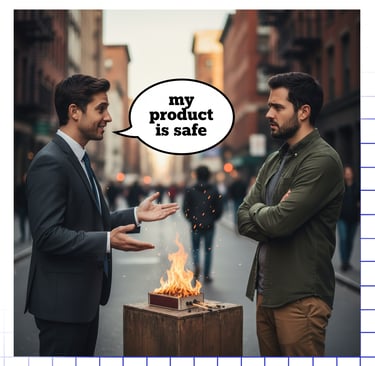
Typical answers include, “Oh my product is safe”, “my product is equivalent to another product (and hence by extension it is safe)”, “We don’t need to do anything/much * “
(*delete as applicable).
Let’s deal with these one by one:
“My product is safe” - what effort and what documentation to prove the effort do you have to justify this statement? It’s the most simple of starting points and the one that I find myself responding with the most. plus as we always say in Quality, if there’s no document, no proof of effort, then ‘it’ (the activity alleged) doesn’t exist. Typically, a challenge on the evidence of documentation will lead to the next statement:
“My product is equivalent to another”. I find ‘Equivalency’ is such an interesting concept. If a product is truly the same as another, than what marketable value does the new product have? I can accept the potential of 100% ‘Me Too’ products that aim to take a market share of an existing product**. However, more likely there will be some difference between the products.
**and actually being equivalent to an existing product can itself be a risk eg in Human Factors, product mixing, intuitive use etc.
For start-ups, where innovation is key, I strongly assume there’s some element that is new, innovate and hence different to the predicate, equivalent device.
So the effort has to be to focus on that difference: for elements of a product, of the product’s design and use that can be proven 100% equivalent to an existing product with minimal risk from that existing product. That way, once this is proven, then the significant effort can be on what is new and different.
Plus, when I say 100%, I mean 100%, because if it’s not 100% the same for design, use or even manufacture for the product or feature, then it is different .....and different = risk to be assessed. It may well be that it’s simple to position how it’s minimal risk by being different, but the expectation is making the effort and documenting it, rather than assumption or casual statement.
“We don’t need to do anything”, you can hear the klaxons ringing because, yes, you do.
“We don’t need to do much”, ‘much’ = yet another of those undefinable unquantifiable statements: the effort and hence resulting documentation would be relative to the risk of the product and specially the patient Harm.
Overall, this effort of assessment and resulting documentation is seen as a burden, specifically a cost, especially for start-ups.
The mindset for this has to be changed: those start-ups (and investors of the start-ups) that choose to understand that this is a) required and b) value-added, will be the ones that will profit from the effort.
Risk Management is not a casual activity.